
War, Evil, and the Christian Conscience
When Peace Feels Fragile
War has a way of stripping away illusions. It exposes the fragile line between order and chaos and reminds us that evil is not theoretical. It moves through human hearts, systems, and ideologies, and when it does, ordinary people pay the price.
Before entering full-time ministry, nearly three decades of my life were spent standing in places where that reality was unavoidable. I first served as an officer in the United States Marine Corps and later spent twenty-four years as a Special Agent with the United States Secret Service. Much of that work centered on a simple responsibility: standing between those who sought to do harm and those entrusted to our protection.
You learn quickly in those environments that peace does not maintain itself. Vigilance matters. Courage matters. Clarity about danger matters. Without those things, chaos has a way of moving in.
Those years shaped how I read Scripture and how I understand the world. They taught me that peace is precious, but never automatic. They also reinforced something equally important. Every life matters.
Behind every geopolitical crisis are ordinary people. Families trying to live quietly. Children who simply want safety. Communities longing for stability. When conflict erupts between nations, it is these lives that are most disrupted.
Scripture reminds us why their suffering matters. “So God created man in his own image, in the image of God he created him” (Genesis 1:27, ESV). Every civilian life carries that imprint. Each one bears a dignity given by God Himself.
Followers of Christ cannot treat human suffering as an abstract political outcome. Compassion is not weakness. It is obedience.
“Behind every geopolitical crisis are ordinary people. Families trying to live quietly. Children who simply want safety.”
Evil Is Not an Illusion
Compassion alone does not explain the world we live in.
Scripture speaks plainly about evil. It does not treat it as a misunderstanding or a temporary diplomatic failure. The Bible teaches that humanity’s rebellion against God produces real darkness in the world, darkness capable of shaping leaders, ideologies, and entire nations.
History confirms this reality. When power joins deception, the innocent suffer.
The apostle Paul described the deeper reality behind these struggles. “For we do not wrestle against flesh and blood, but against the rulers, against the authorities, against the cosmic powers over this present darkness” (Ephesians 6:12).
The ultimate conflict is not merely between nations or peoples. It is between truth and falsehood, light and darkness.
Christians believe salvation is found in Christ alone. Any worldview that denies the person and work of Jesus ultimately leads people away from that truth. The Church has always spoken with clarity about this while remembering that those who follow other paths are not enemies but neighbors who bear the image of God.
We reject deception. Yet we pray for those who live within it.
The Responsibility to Restrain Evil
The current tensions involving Iran and the wider Middle East remind us how complex these questions can be. Christians should approach such conflicts with sober realism, compassion for the innocent, and moral clarity about the responsibility to confront evil.
Scripture also speaks about the role of civil authority in a fallen world. “For he is God’s servant for your good… he does not bear the sword in vain” (Romans 13:4).
Governments exist, in part, to restrain evil. That responsibility becomes painfully practical whenever aggression threatens lives or destabilizes entire regions.
The modern world is not immune to these realities. Terrorism still targets civilian populations. Some movements openly embrace violence as a means of advancing their aims, and at times such efforts are sustained not merely by isolated actors but by governments willing to tolerate, sponsor, or enable them.
Christians must approach these realities with clear eyes and sober hearts. At the same time, we should pray for the people of Iran and throughout the region, many of whom long for peace, stability, and freedom from the forces that keep their nations caught in cycles of conflict.
“War is always a tragic failure of peace. Yet history reminds us that when destructive forces are left unchallenged, injustice rarely remains contained.”
The Moral Limits of War
For centuries, the Church has wrestled with the tension between Christ’s call to peace and the responsibility to defend the innocent. Christian thinkers such as Augustine and Thomas Aquinas developed what has become known as the Just War tradition. Their aim was not to justify violence but to place moral boundaries around it.
Augustine argued that the ultimate aim of war must be the restoration of peace, not the pursuit of vengeance. War must therefore be approached with restraint, moral clarity, and grave seriousness.
War must have a just cause. Authority must be legitimate. The response must be proportionate. Civilians must be protected. Every reasonable effort toward peace should be exhausted before force is used.
These principles grew from careful reflection on Scripture and history.
John the Baptist spoke to soldiers without commanding them to abandon their profession. Instead he told them to act justly. “Do not extort money from anyone by threats or by false accusation, and be content with your wages” (Luke 3:14).
Jesus also spoke about sacrificial protection. “Greater love has no one than this, that someone lay down his life for his friends” (John 15:13).
History reminds us what happens when evil expands unchecked. The twentieth century offers sobering reminders. From Nazi tyranny in Europe to modern terrorist movements that target civilians, history shows that evil does not restrain itself.
Across the centuries, destructive regimes and movements advanced until someone finally stood in the gap to resist them.
Scripture reminds us that responsibility accompanies power. “Everyone to whom much was given, of him much will be required” (Luke 12:48).
Some nations possess resources and capacities that others do not. With that strength comes a moral burden. Power must never be used for domination or revenge, but there are moments when it must be used to protect those who cannot defend themselves.
Contemporary Christian thinkers continue to wrestle with these questions. As theologian Albert Mohler has observed, the Christian tradition does not celebrate war, but it does recognize that governments sometimes bear the responsibility to confront evil in order to protect the innocent.
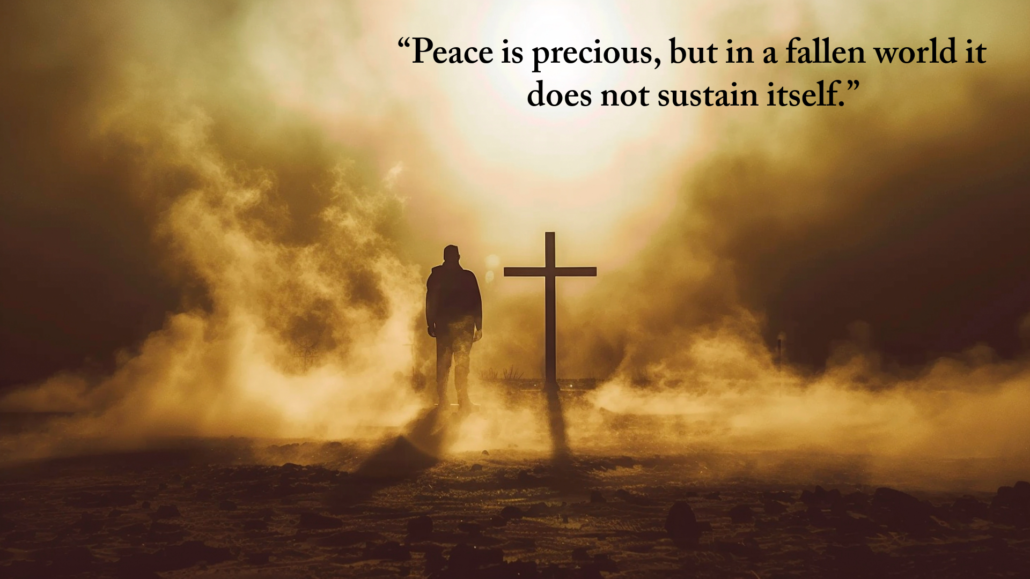
“Peace is precious, but in a fallen world it does not sustain itself.”
A Higher Allegiance
At the same time, the Church itself is not defined by national power. Our allegiance is higher. “But our citizenship is in heaven” (Philippians 3:20). Christians serve Christ across every nation and profession. Many work in regions where instability is not theoretical but part of daily life.
Followers of Christ must refuse two temptations that dominate public discussion. One is hatred that dehumanizes entire peoples. The other is naïve optimism that refuses to acknowledge the presence of evil. Christians pursue peace while holding firmly to truth.
Believers working in business, leadership, and public life carry particular influence. Scripture calls us to pray for those entrusted with authority. “I urge that supplications, prayers, intercessions, and thanksgivings be made for all people… for kings and all who are in high positions” (1 Timothy 2:1–2).
Leadership decisions made in moments of global tension affect millions of lives. Pray for those called to bear that responsibility.
The Bible does not promise that the world will become peaceful before Christ returns. It promises something greater. Jesus said, “In the world you will have tribulation. But take heart; I have overcome the world” (John 16:33). That promise steadies believers in turbulent times.
The Church continues its mission amid a broken world. We pray for peace. We defend the vulnerable. We speak truth without fear. There will be chaos. There will be violence. Nations will rage, and conflict will persist. Scripture never pretends otherwise. Yet none of it unfolds outside the sovereign hand of God. God continues to raise up chosen instruments who stand in the gap, restraining evil and protecting the innocent.
So do not lose heart. History is not spinning out of control. It is moving toward the day when Christ will reign openly over all that He has made.
Until then, we live and labor with steady confidence. We strive for what is good, we stand against what is evil, and we remain grateful for the grace of God in a world that is still broken, yet still deeply loved by its Creator.
Christopher C. Simpson is President of CBMC International, the world’s oldest and largest evangelical marketplace ministry. He previously served as an officer in the United States Marine Corps and spent twenty-four years as a Special Agent with the United States Secret Service.